
Beyond THC – What Educated Cannabis Consumers Are Actually Shopping For
Walk into a dispensary for the first time and the question you will hear most often — from staff and from the voice in your own head — is some version of “how strong is this?” THC percentage has become the default way most consumers evaluate cannabis, the same way alcohol by volume guides a wine purchase or a beer selection. Higher number, stronger product, better value. Simple.
Except it is not that simple, and a growing number of consumers are figuring that out. The THC-first mindset is giving way to something more nuanced, and it is changing how people shop, what they ask for, and which dispensaries earn their loyalty.
The THC Trap
The fixation on THC percentage is understandable. It is the one metric that is always front and center on every label, and it maps to a straightforward assumption: more THC equals a more powerful experience. For a new consumer, that shorthand feels like useful information.
The problem is that it is misleading. Research and real-world experience consistently show that THC percentage alone is a poor predictor of the quality or character of a cannabis experience. A 30% THC flower can feel less impactful than a 20% strain — not because the lab numbers are wrong, but because THC is only one variable in a much more complex equation and there is more to the story than concentration.
This is something that experienced consumers discover through trial and error. They buy the highest-testing product on the shelf, have a mediocre experience, and start wondering what they are missing. That moment of curiosity is where the education begins.
Enter Terpenes
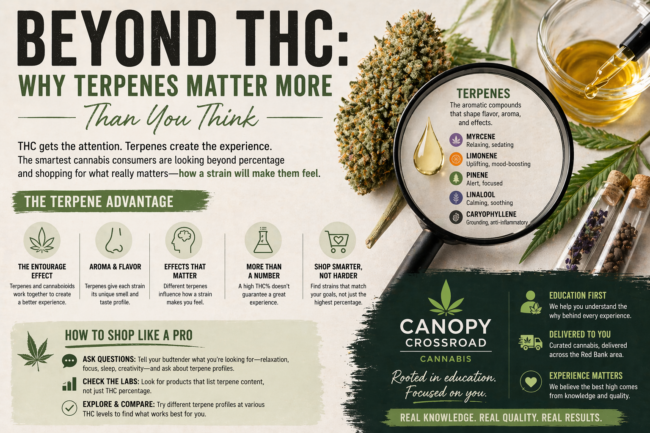
If THC is the headline, terpenes are the story. Terpenes are the aromatic compounds found in cannabis — and in countless other plants — that give each strain its distinct smell, flavor, and, increasingly, its effect profile. They are the reason a strain that smells like pine hits differently than one that smells like citrus, even if both test at similar THC levels.
The science is still evolving, but the evidence points toward what researchers call the entourage effect — the idea that cannabinoids like THC and CBD work in concert with terpenes and other plant compounds to produce the overall experience. A strain rich in myrcene may feel more sedating. One high in limonene may feel more uplifting. Linalool, found in lavender as well as cannabis, is associated with calming effects.
This is not fringe thinking anymore. Terpene profiles are increasingly featured on dispensary menus, lab reports are getting more detailed, and a subset of consumers now shops by terpene profile the way a wine enthusiast shops by grape varietal and region rather than just alcohol content.
How Shopping Behavior Is Shifting
The practical impact is visible at the dispensary level. Educated consumers ask different questions. Instead of “what has the highest THC?” they ask “what terpenes are in this?” or “what would you recommend for relaxation versus focus?” They are looking for specific experiences rather than just potency, and they are willing to try lower-THC products if the terpene profile suggests a better fit for what they want.
This shift rewards dispensaries that invest in education. The shops that train their budtenders to talk about terpenes, that organize their menus by effect profile rather than just THC percentage, and that curate their product selection around quality and variety rather than just chasing the highest numbers — those are the dispensaries building loyal customers.
Canopy Crossroad in Red Bank, New Jersey is a good example of this approach. As a women-owned dispensary built around education and science, they have leaned into terpene education through their blog content, staff training, and product curation. Their approach treats customers as people who want to understand what they are buying, not just grab the strongest option off the shelf. And for customers who want to explore terpene-focused products without making a trip, Canopy Crossroad now delivers across the Red Bank area — making it easy to browse their curated menu from home and try something new.
What This Means for the Industry
The terpene-aware consumer is still a minority, but it is a growing one — and it is a disproportionately valuable one. These customers tend to buy more frequently, explore more products, and develop stronger loyalty to dispensaries that serve their curiosity. They are also more likely to recommend a dispensary to friends, because their recommendation comes with a reason beyond “they had cheap weed.”
For the industry, this matters because it shifts competition away from a race to the bottom on price and THC percentage — which benefits nobody in the long run — and toward a race to the top on quality, curation, and expertise. That is healthier for dispensaries, better for consumers, and ultimately better for the reputation of the legal market as a whole.
How to Start Shopping Smarter
If you have been buying cannabis based on THC percentage alone and want to start thinking differently, here are a few practical starting points.
Look at the terpene profile on the label or menu listing. Most legal products now include this information. If a strain is high in myrcene, expect more body-heavy, relaxing effects. If it is high in limonene or pinene, expect something more energizing and clear-headed. Caryophyllene, which smells peppery, is associated with anti-inflammatory properties.
Ask your budtender. The good ones love this question. Tell them what kind of experience you are looking for — relaxation, focus, creativity, sleep, social energy — and let them guide you to a product based on the full profile, not just the THC number.
Try a lower-THC product on purpose. Pick a strain in the 15 to 20 percent range with a terpene profile that interests you and compare the experience to your usual high-THC purchase. Many people are surprised to find that the lower-testing product delivers a more enjoyable, more nuanced experience.
Keep a simple log. Note what you tried, the dominant terpenes, and how it felt. After a few purchases, patterns will emerge that help you zero in on the profiles that work best for you.
The Bigger Picture
The cannabis market is maturing, and consumer behavior is maturing with it. The early days of legalization were defined by novelty and a THC arms race. The next phase is being defined by education, nuance, and a deeper understanding of what the plant actually does and why.
That is a good thing — for consumers who get better experiences, for dispensaries that compete on knowledge rather than just price, and for an industry that is slowly earning the same kind of product sophistication that exists in wine, coffee, and craft beer.
THC will always matter. But it is no longer the whole story, and the consumers who figure that out first are the ones having the best experiences.