
Emface Treatment vs Traditional Anti-Ageing Procedures: Understanding the Differences
As interest in non-surgical cosmetic procedures continues to grow, Emface treatment has emerged as an innovative option for people looking to address the visible signs of ageing without injections or surgery. Unlike many traditional anti-ageing treatments, Emface combines radiofrequency energy with high-intensity facial muscle stimulation to improve skin quality while simultaneously strengthening the muscles that support the face. This dual approach has attracted attention from individuals seeking natural-looking facial rejuvenation with minimal disruption to their daily lives. Understanding how Emface differs from more established procedures can help people make informed decisions about which treatment best suits their individual goals.
Ageing affects the face in several ways. Over time, the skin gradually loses collagen and elastin, making it thinner and less elastic. Fat distribution changes, facial muscles weaken, and the supporting structures beneath the skin begin to lose strength. The combined effect is the appearance of fine lines, wrinkles, sagging skin and reduced facial definition. Traditional cosmetic procedures have typically focused on treating one or more of these changes individually, whereas newer technologies increasingly aim to address multiple aspects of facial ageing at the same time.
One of the most familiar anti-ageing procedures is Botox. Botox works by temporarily relaxing selected facial muscles responsible for creating dynamic wrinkles, such as forehead lines, frown lines and crow’s feet. By reducing muscle movement, the overlying skin becomes smoother, making expression lines less noticeable. The treatment is highly effective for wrinkles caused by repeated facial movements, but it does not improve skin quality directly or strengthen facial muscles.
Dermal fillers represent another popular treatment option. Rather than relaxing muscles, fillers restore lost facial volume using injectable substances, most commonly hyaluronic acid. They can enhance cheeks, lips, jawlines and other facial features while also softening deeper folds. Fillers are particularly useful where age-related volume loss has contributed to changes in facial contours. However, they work differently from Emface, which focuses on stimulating the body’s own tissues rather than adding volume through injected materials.
Surgical facelift procedures remain the most comprehensive solution for significant facial ageing. Surgery can reposition deeper tissues, remove excess skin and produce dramatic improvements in facial appearance. However, surgical procedures involve anaesthesia, recovery time, greater expense and higher levels of risk compared with non-invasive treatments. While facelift surgery remains appropriate for some individuals, many people now prefer less invasive alternatives that involve little or no downtime.
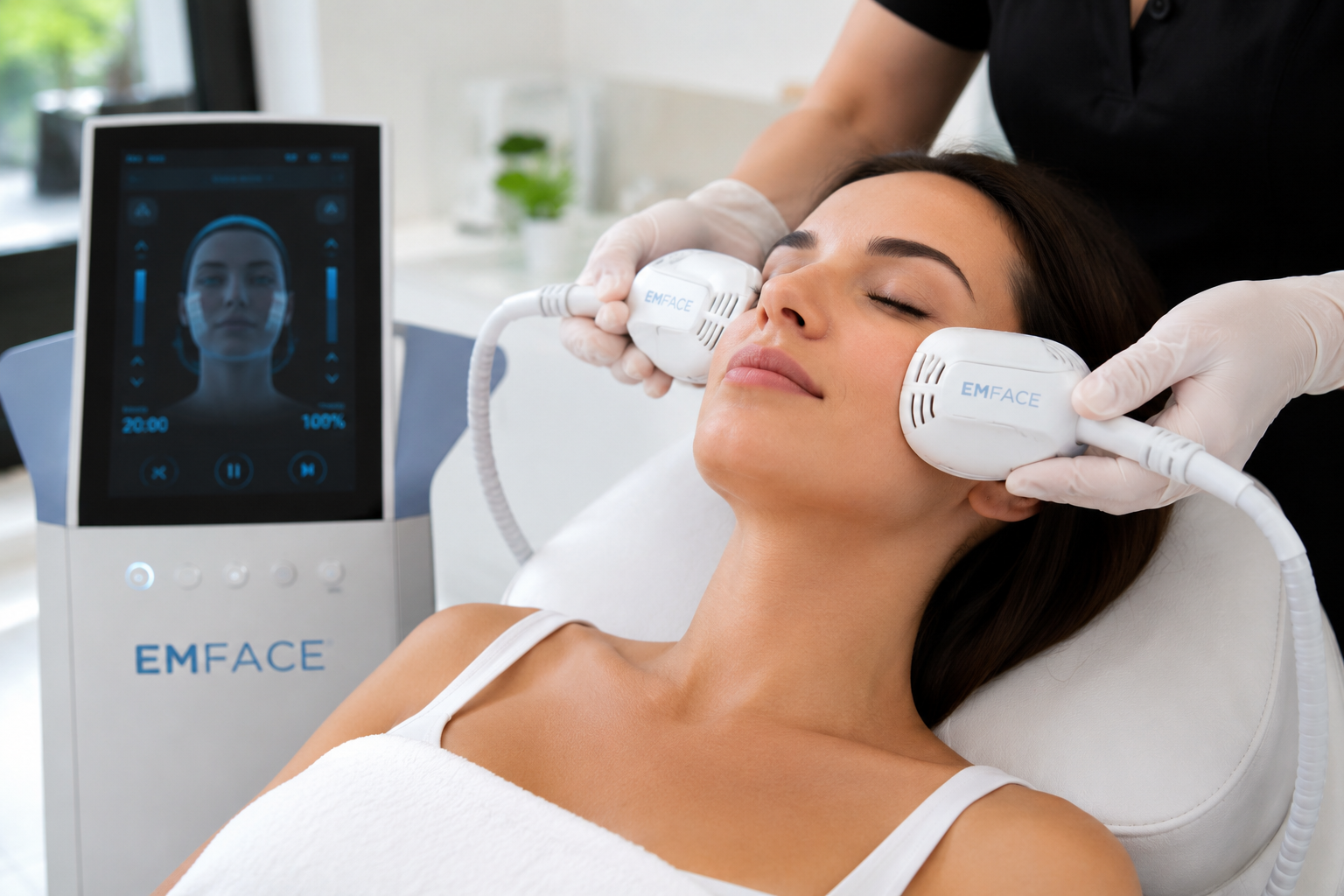
This is where Emface introduces a different approach. Rather than relying on injections or surgical intervention, the treatment combines synchronised radiofrequency with high-intensity facial electrical stimulation. The radiofrequency component gently heats the skin to stimulate collagen and elastin production, while the electrical stimulation contracts targeted facial muscles. These repeated contractions are designed to strengthen muscles that naturally weaken with age, helping improve facial support from beneath the skin.
The concept is similar to strengthening muscles elsewhere in the body through exercise. While facial muscles differ from skeletal muscles in many respects, improving their tone may contribute to enhanced facial definition and a lifting effect. At the same time, increased collagen production supports improvements in skin texture, elasticity and firmness. By targeting both the skin and underlying muscles simultaneously, Emface aims to provide comprehensive facial rejuvenation without puncturing the skin.
Another important difference lies in the treatment experience itself. Botox and dermal fillers both involve injections, which some individuals may find uncomfortable or simply wish to avoid. Emface is entirely needle-free. During treatment, specially designed applicators are placed onto the face, where they deliver controlled energy over a series of treatment cycles. Most patients describe the sensation as warmth combined with rhythmic muscle contractions rather than pain.
Treatment sessions are also relatively convenient. Appointments generally last around twenty minutes, and patients can usually resume normal activities immediately afterwards. There is typically no bruising associated with injections and no recovery period comparable to surgery. This makes Emface particularly attractive for busy individuals who want cosmetic improvements without taking time away from work or social commitments.
Results also develop differently compared with other procedures. Botox generally begins working within several days, while dermal fillers provide immediate volume enhancement. Surgical results become visible after swelling subsides over several weeks or months. Emface, by contrast, relies on the body’s natural biological response. As collagen production increases and facial muscles adapt to repeated stimulation, improvements tend to appear gradually over several weeks following a course of treatments. This progressive change often results in subtle, natural-looking improvements rather than an immediate transformation.
Another distinguishing feature is the overall aesthetic outcome. Because Emface does not relax facial muscles in the same way as Botox, patients continue to display normal facial expressions. Instead of limiting muscle movement, the treatment seeks to improve the quality of both the skin and its underlying support structures. Many people appreciate this approach because it aims to enhance natural appearance while preserving individual facial character.
The suitability of each treatment depends largely on a person’s concerns and expectations. Someone primarily troubled by deep expression lines may benefit most from Botox, while volume loss may be better addressed using dermal fillers. Individuals with advanced skin laxity may ultimately require surgical intervention to achieve their desired results. Emface may be particularly appropriate for people with mild to moderate signs of ageing who want gradual improvement in facial tone, skin quality and overall appearance without injections or surgery.
In many cases, treatments are not mutually exclusive. Experienced aesthetic practitioners often develop personalised treatment plans that combine different procedures according to each patient’s needs. Emface may complement Botox, fillers or other skin rejuvenation treatments by addressing aspects of ageing that each individual procedure cannot fully correct on its own. A thorough consultation allows practitioners to assess facial anatomy, discuss treatment goals and recommend the most appropriate combination where suitable.
Safety remains an important consideration with any cosmetic procedure. Although Emface is non-invasive, it should still be performed by appropriately trained professionals who understand both the technology and patient selection. During the consultation, practitioners should review medical history, assess skin condition and identify any circumstances that may make treatment unsuitable. Patients should also receive realistic information regarding expected outcomes and the number of sessions likely to be required.
One of the greatest strengths of modern aesthetic medicine is the increasing range of treatment options available. Rather than relying on a single solution for every patient, practitioners can now tailor treatment plans according to individual anatomy, lifestyle and cosmetic objectives. This personalised approach often leads to more balanced, natural-looking results while allowing patients to choose procedures that align with their comfort levels and expectations.
As non-surgical facial rejuvenation continues to evolve, technologies such as Emface are expanding the possibilities for those seeking subtle improvements without invasive procedures. By combining muscle stimulation with collagen-building radiofrequency, the treatment offers a distinctive alternative to traditional anti-ageing options. While Botox, dermal fillers and surgery all continue to have valuable roles within aesthetic medicine, Emface provides another pathway for individuals who want to improve facial appearance through a completely needle-free approach that supports both the skin and the muscles beneath it.